Ukraine: why rents are rising in some cities despite the war
Destroyed homes, displaced households and demand concentrated in relatively less exposed areas: the conflict is reshaping the geography of housing. The rises seen in Lviv show that a country at war can experience shortage, rising costs and destruction of assets all at once.

Gaston michelin
Agent immobilier
The idea seems contradictory: how can rents rise when war destroys homes and weakens the economy? Ukraine offers a concrete answer. People do not stop needing a roof. They look for housing elsewhere, sometimes in a small number of cities where they hope to find more stable living conditions. Demand then shifts faster than buildings can be built. Prices become the reflection of a localised shortage, with particularly heavy consequences for families who have already lost their home or their income.
A rise measured in Lviv, within a precise scope
In early October 2026, the property platform LUN reported a 34% increase over six months in rents for one-room apartments in Lviv, expressed in hryvnias. Its commentary linked the sustained demand to the appeal of relatively less exposed regions. This figure concerns one city, one type of housing and one given period; it does not represent all Ukrainian rents. [1]
The currency of measurement also matters. A change in local currency is not directly comparable with a rise of the same size in euros. Advertised rents are also not an exhaustive record of signed contracts. These caveats take nothing away from the tension observed: they help us understand exactly what it measures.
LUN’s other indicators also show a geographically differentiated market. On its page on new-build housing, consulted on 4 November, the levels shown for Lviv exceeded those for Kyiv. This snapshot is not enough to rank cities definitively by property value; it does show, however, that the capital does not systematically hold the highest prices in every segment. [2]
Destruction reduces supply just as needs change
The RDNA5 assessment published in February 2026 by the Ukrainian authorities, the World Bank, the European Commission and the UN estimates that 14% of the housing stock had been damaged or destroyed by the end of December 2025, affecting more than three million households. Reconstruction and recovery needs in the residential sector approached 90 billion dollars. [3]
These asset figures shed light on the rental market. A damaged home does not always disappear from stock statistics, but it may no longer offer an immediately usable solution. Repairing requires materials, contractors, financing and working utility networks. Housing available in the short term thus becomes scarcer than the number of buildings still visible might suggest.
In host cities, this additional demand meets a housing stock built for a different population. Dividing an apartment, renovating a vacant home or delivering a residential scheme takes time. Even as construction and repair move forward, they do not necessarily keep pace with the timetable of population movements.
Winter brings energy into the search for housing
On 16 October, the International Organization for Migration warned of the risk of new displacement linked to damaged homes and attacks on energy infrastructure. It estimated at nearly 3.6 million the number of people still displaced inside the country. Returning home therefore does not guarantee being able to stay there. [4]
The issue cannot be reduced to a line between “safe” and “dangerous” cities. Conditions can change. The availability of heating, water and electricity also changes the real usability of an apartment. A theoretically cheaper home becomes hard to live in when its day-to-day operation is no longer assured.
For households, the budget must then include other expenses: transport, emergency equipment, heating and possible extra mobility. A comparison limited to monthly rent misses part of the constraint. This search for housing that is genuinely usable can reinforce the concentration of demand on certain buildings or neighbourhoods.
Prices can rise while access to housing deteriorates
A rise in property prices is not always a sign of prosperity. In a context of forced displacement, it can reflect heightened competition for habitable homes. Owner-occupiers and tenants do not experience this situation in the same way. A rise in asking prices does not improve the budget of a family that has to rehouse itself immediately.
The question of affordability becomes central. A rent that looks modest to a foreign observer can represent a very high share of a local income. Simply converting amounts into euros risks masking this relationship. The analysis must set housing costs against resources, household size and job stability.
This tension can also push people into compromises: smaller space, shared housing, longer distances or staying with relatives. These solutions absorb part of the need without appearing as new homes. They show why market observation must be supplemented by surveys of living conditions.
What can be concluded, and what remains uncertain
The available data establish strong pressure in certain western markets and massive needs for repair. They do not allow a single national price to be constructed that would sum up the situation. The differences between new-build, existing homes, rental listings and contracts actually concluded must remain visible.
It would also be premature to deduce a price trajectory after the war. Population returns, reconstruction, financing and the restoration of services could shift the balance. Several scenarios are conceivable, depending on how long the damage lasts and on the possibilities for resettlement.
A real estate lesson that goes beyond Ukraine
The Ukrainian case highlights three fundamental determinants: where households are located, the availability of habitable homes and the continuity of services. When they change abruptly, prices can move in opposite directions a few hundred kilometres apart.
To read a property market, one must therefore always ask who is looking for housing, where and under what conditions. A national average does not tell the needs of a displaced family or the situation of a host city. The value of this analysis is to explain the transformation of housing and its human costs, while keeping a clear distinction between rising prices and improving living conditions.
Sources
[1] LUN - Rent statistics in Lviv - Early October commentary; page consulted on 4 November 2026
[2] LUN - Ukrainian new-build residential market statistics - Consulted on 4 November 2026; data subject to change
[3] World Bank and partners - RDNA5 assessment - 23 February 2026; situation as at 31 December 2025
[4] IOM - Risks of new displacement before winter - 16 October 2026
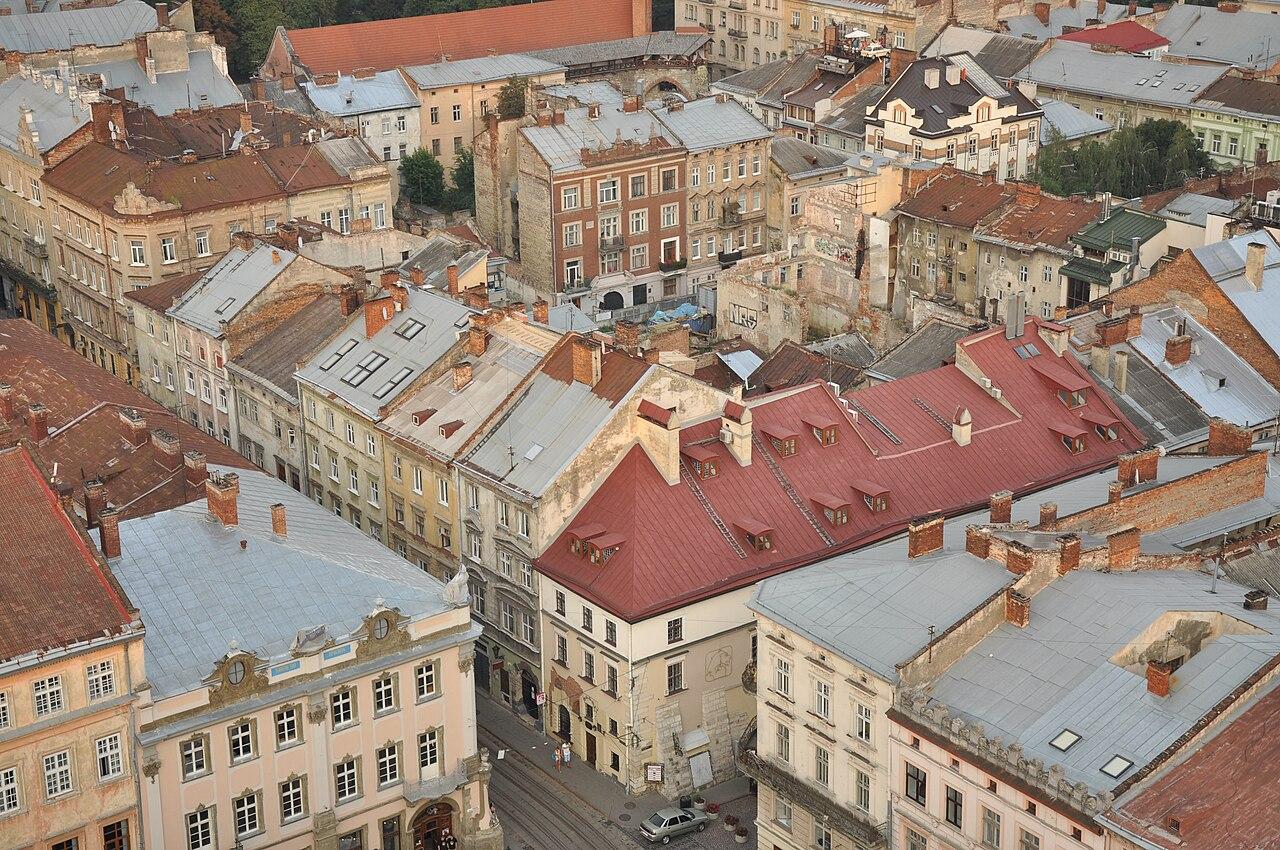
Photo credit: Jorge Láscar from Australia, Old Town (8674962314).jpg / Wikimedia Commons — CC BY 2.0. View of Lviv in August 2012, before the 2022 invasion: an illustrative photograph, not showing the current state of the buildings.