Grand Paris Express: how to buy near a future station without overpaying for the wait
Upcoming openings will change journeys and the appeal of certain neighbourhoods. But the timetable, the walking route and the price buyers have already paid matter as much as a station appearing on a map. Here is how to examine the transport promise in a property project.

Gaston michelin
Agent immobilier
“Close to the future metro”: the phrase appears in many Île-de-France listings. It can reflect a genuine change of life, but it is not a property valuation. A new station improves some journeys, changes how the neighbourhood is used and can widen demand. You still need to know when it will open, which journeys it will ease and how much of that improvement is already built into the price. To buy around the Grand Paris Express, the promise must be translated into minutes, a timetable and a budget.
Upcoming openings must be read section by section
In a release dated 22 September 2026, the Société des grands projets announces the first section of Line 18, between Massy-Palaiseau and the Saclay plateau, for December 2026. It also describes the final steps before opening to the public: tests, preparation for operation and safety validations. [1]
The overall timetable places Line 15 South, between Pont de Sèvres and Noisy-Champs, in 2027. Line 18 is then due to reach Orly in 2027 and Versailles-Chantiers in 2030 according to the stages announced. These dates must be checked for the segment that is really useful to the future occupant. [2]
Buying near a station therefore does not mean benefiting immediately from the whole future network. An interchange, a branch or an extension may follow a different timetable. This difference can be decisive for a family that has to organise its journeys from the moment it moves in.
The transport gain must be calculated door to door
The distance drawn on a plan does not describe the daily journey. You need to measure the walk to the station entrance, crossings, access points, interchanges and the final route to work or school. A home described as “close” may require a less direct route than it appears.
The exercise must be done for the destinations actually used. A highly efficient link to an employment hub may bring little benefit to a household whose journeys follow another axis. The usage value of the metro therefore depends on the resident’s profile, and not only on the number of nearby stations.
A teaching example shows what is at stake: twenty minutes saved per journey, twice a day and five days a week, amounts to three hours and twenty minutes a week. This gain can weigh heavily in the choice of a home. It does not, however, automatically turn into a set amount of capital gain.
The station sits within a changing neighbourhood
The surroundings of new stations may receive housing, shops, public spaces or new facilities. These projects must be distinguished from the metro coming into service. Their timetable, funding and stage of progress may be different.
For a buyer, the visit must therefore include the neighbourhood: shops already open, schools, walking routes, outdoor spaces and existing nuisances. Future developments can complete this reading, but the uses available on the day of purchase must remain visible in the decision.
A construction period can also continue after the station opens. Temporary access, building deliveries and traffic changes should be examined in the local documents. Day-to-day comfort in the short term and the neighbourhood’s potential over the longer term are two distinct pieces of information.
An expected improvement may already be in the price
Sellers and buyers have often known about the metro project for several years. Part of its future appeal may therefore have been built into prices before the first train arrives. Buying just before opening does not necessarily give access to a rise that is still entirely to come.
The comparison must rely on recent sales in the same area and on homes with similar characteristics. It is useful to look at several distances from the station and several streets, taking account of noise, facilities and the condition of buildings.
The Grand Paris notaires’ map provides a benchmark drawn from transactions. Its standardised prices rest on sales over the last three months available and seek to limit the effect of differences in quality between properties. They must be related to the characteristics of the apartment under study. [3]
The general market context still matters
A favourable transport project does not erase the evolution of credit and purchasing power. In their 29 October release, the Grand Paris notaires report a 2% year-on-year fall in Île-de-France sales between June and August, with differences by type of property and by département. [4]
A well-served address can thus remain in demand in a slower market, while still needing a consistent price. The buyer must keep a budget for fees, works and charges. Transport potential does not automatically make up for a run-down building or a financially stretched deal.
For a rental investment, you must also examine the rents that are actually sustainable, the rules that apply and the demand from the intended occupants. The arrival of new homes near a station can widen the residential neighbourhood while increasing competition between landlords.
Test several timetables before committing
A solid project can be examined in three situations: the announced timetable is met, opening comes later, or the neighbourhood’s developments take longer. For each, you must check the daily journey, the holding cost and the ability to keep the home.
This exercise does not claim to predict delays. It helps to understand which conditions are essential to the project. If the home becomes attractive only in a very specific scenario of transport and quick resale, the price or the structure deserves to be re-examined.
The seller also has an interest in documenting their arguments: name of the station, real access, section and published timetable. A precise listing will be more convincing than a general promise of appreciation. It lets buyers assess a concrete benefit.
Linking the metro to your life plans
The Grand Paris Express can durably change how many areas are used. Its property interest, however, is measured at the scale of a journey, a neighbourhood and a property. Future service complements the usual fundamentals: condition, charges, environment and budget.
Before paying a premium for an announced station, have the real difference it makes to your project examined. LGH Patrimoine helps you read the local market and comparables so as to give transport its fair place in the price, without making the whole decision depend on future appreciation.
Sources
[1] Société des grands projets - Final steps before commissioning - 22 September 2026
[2] Grand Paris Express - Timetable and Line 18 - Timetable consulted on 4 November 2026
[3] Notaires du Grand Paris - Price map and methodology - Prices at end August 2026; consulted on 4 November
[4] Notaires du Grand Paris - Market trends, June to August 2026 - 29 October 2026
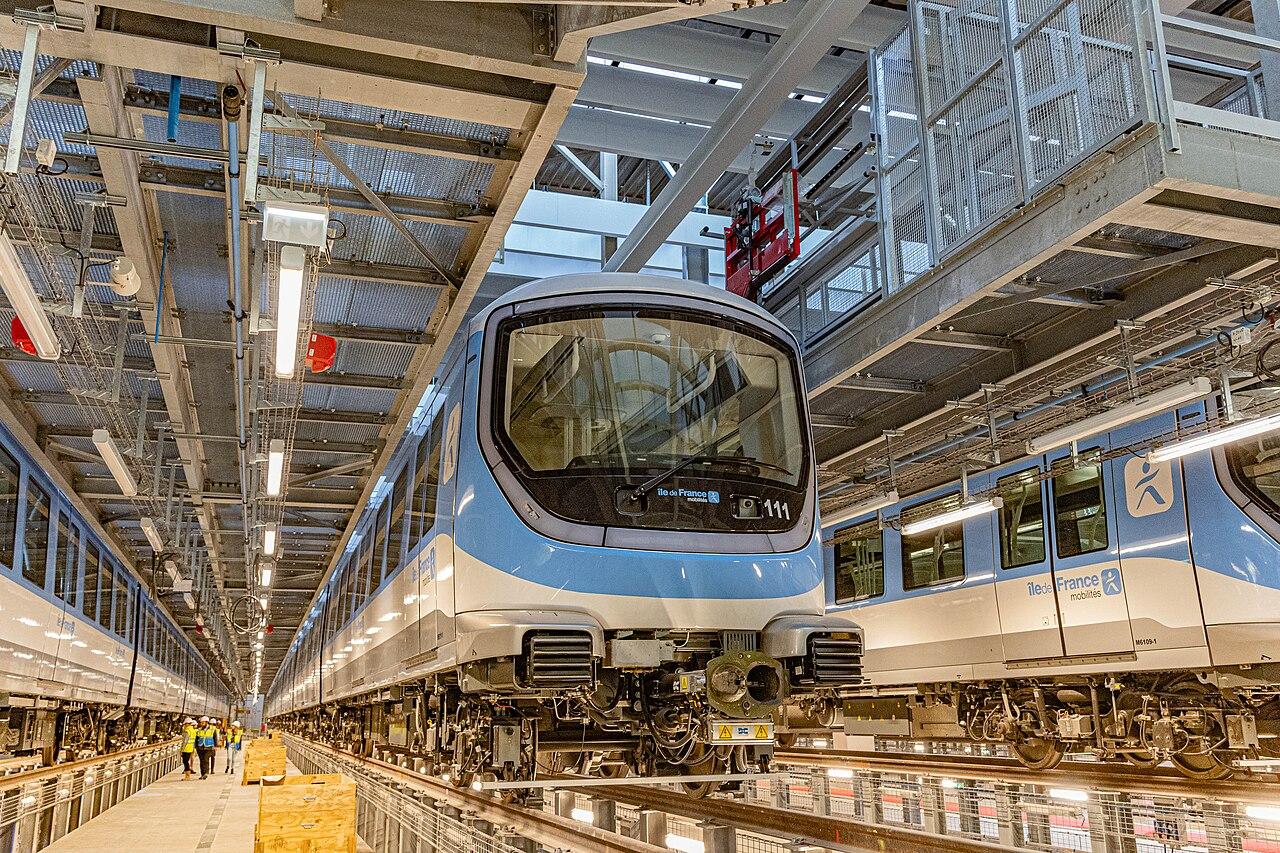
Photo credit: Adnane302, CE Champigny du Grand Paris Express MR6V "2".jpg / Wikimedia Commons — CC0. Line 15 train photographed in a technical centre at Champigny on 10 April 2025, not in a station already open to the public; image resized by the source.